Introduction
The way people search for travel information is changing rapidly. For nearly two decades, search engines displayed a list of websites, and users clicked through multiple pages before making a booking decision. Today, Artificial Intelligence (AI) is transforming this experience. Instead of presenting only links, AI platforms provide direct answers, personalized recommendations, travel itineraries, and comparisons within seconds.
Travelers now ask questions such as:
- “What is the best honeymoon destination in October?”
- “Suggest a 5-day family itinerary for Kerala.”
- “Which beach resort near Chennai is suitable for children?”
- “Best budget hotels in Singapore with free breakfast.”
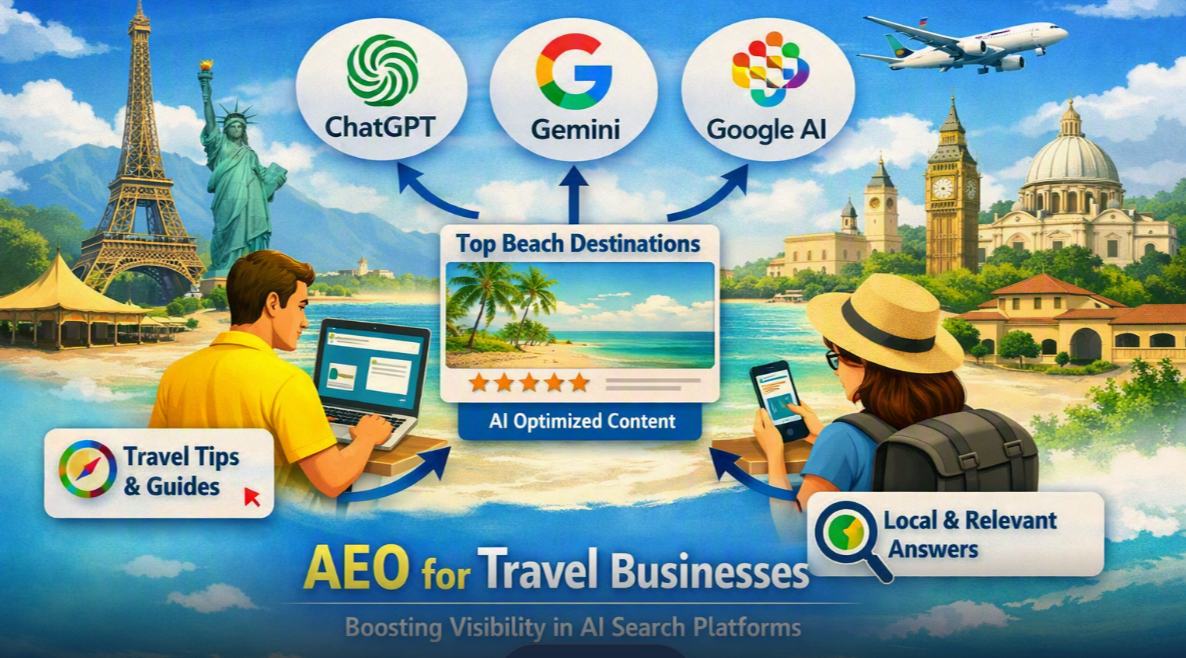
These questions are increasingly answered by AI assistants such as ChatGPT, Google AI Mode, Gemini, Microsoft Copilot, Claude, and Perplexity. This shift has created a new discipline known as Answer Engine Optimization (AEO).
For the travel industry, AEO represents one of the biggest opportunities since the emergence of search engines. Businesses that adapt early can become the preferred recommendations of AI systems, while those relying only on traditional SEO risk becoming less visible.
What is Answer Engine Optimization?
Answer Engine Optimization (AEO) is the process of optimizing digital content so that AI-powered search platforms can understand, trust, and recommend your business when users ask natural-language questions.
Unlike traditional SEO, which focuses on improving rankings in search results, AEO focuses on increasing the likelihood that AI platforms directly reference or recommend your business in their answers.
The objective is no longer simply appearing on the first page of search results—it is becoming part of the answer itself.
Why the Travel Industry is Ideal for AEO
Travel decisions involve extensive research. Travelers compare destinations, hotels, transportation, weather, activities, budgets, reviews, and local experiences before making a booking.
This creates thousands of opportunities for AI systems to recommend businesses.
Common AI travel queries include:
- Best destinations for solo travelers
- Affordable family vacation packages
- Luxury resorts near beaches
- Weekend trips from Bengaluru
- Visa-free countries for Indian travelers
- Best wildlife safari experiences
- Adventure tourism destinations
- Corporate travel planning
- Pilgrimage packages
- Eco-tourism destinations
Every question represents an opportunity for a travel business to become visible through AI.
How AI Platforms Select Travel Recommendations
AI systems evaluate far more than keywords. They assess whether a business demonstrates credibility, expertise, and consistency across multiple sources.
Typical factors include:
- Clear business identity
- Well-structured website content
- Consistent information across platforms
- Destination expertise
- Comprehensive travel guides
- Frequently updated content
- Customer trust signals
- Independent mentions
- Structured data
- High-quality FAQs
- Accurate contact information
- Positive online reputation
The more trustworthy your digital presence appears, the greater the likelihood of being recommended.
Traditional SEO vs AEO
Traditional SEO primarily focuses on improving rankings for keywords.
AEO focuses on answering complete user questions.
For example:
Traditional SEO keyword:
“Goa Tour Package”
AEO question:
“What is the best 4-day Goa itinerary for families with children?”
Traditional SEO tries to rank a webpage.
AEO attempts to make your content the answer.
Why Travel Businesses Must Adapt
Consumer behavior is changing rapidly.
Instead of browsing dozens of websites, travelers increasingly ask AI assistants for recommendations.
Examples include:
“I have ₹80,000 for a honeymoon.”
“Plan my Europe vacation.”
“Suggest hotels near the Eiffel Tower.”
“What are the safest destinations for solo women travelers?”
AI provides curated answers rather than a list of links.
If your business is not optimized for AI discovery, it may never appear during these conversations.
Types of Travel Businesses That Benefit from AEO
Almost every segment of the travel industry can benefit:
- Travel agencies
- Tour operators
- Hotels
- Resorts
- Homestays
- Holiday package providers
- Cruise companies
- Adventure tourism operators
- Medical tourism companies
- Religious tourism providers
- Destination management companies
- Travel consultants
- Visa consultants
- Car rental companies
- Travel insurance providers
- Local experience providers
Every business that answers traveler questions has AEO potential.
Content That Performs Well in AI Search
AI systems prefer informative, structured, and comprehensive content.
Examples include:
Destination Guides
Complete city and country guides covering attractions, weather, transport, food, shopping, safety, and costs.
Travel Itineraries
Detailed plans for 2-day, 5-day, or 10-day trips.
Frequently Asked Questions
Answer common traveler concerns clearly and accurately.
Budget Planning
Explain expected travel expenses for different traveler profiles.
Seasonal Guides
Recommend destinations based on seasons, festivals, or weather conditions.
Travel Checklists
Packing lists, visa requirements, vaccination advice, and travel documents.
Comparison Articles
Examples include:
- Bali vs Phuket
- Maldives vs Seychelles
- Dubai vs Singapore
- Backpacking vs Luxury Travel
AI frequently references comparison-based content.
The Role of Structured Data
AI systems understand websites better when information is organized using structured data.
Important structured data for travel websites includes:
- Organization
- Local Business
- Hotel
- Tourist Attraction
- FAQ
- Review
- Product
- Event
- Breadcrumb
- Article
Structured data helps AI identify the relationships between destinations, services, locations, and businesses.
Building AI Trust
AI platforms prefer businesses that demonstrate expertise and credibility.
Ways to build trust include:
- Publish original travel insights.
- Share authentic destination photography.
- Maintain accurate business information.
- Keep content updated regularly.
- Display customer testimonials.
- Highlight certifications and memberships.
- Showcase industry experience.
- Publish travel advisories and updates.
Trust is accumulated over time through consistent, reliable information.
Common AEO Mistakes
Many travel businesses make avoidable mistakes, such as:
- Publishing thin content.
- Using duplicate destination descriptions.
- Ignoring FAQs.
- Outdated pricing.
- Broken website links.
- Inconsistent contact details.
- Missing structured data.
- Poor mobile experience.
- Lack of destination expertise.
- Overuse of promotional language.
AI systems generally favor informative content over purely promotional material.
Measuring AEO Success
Unlike traditional SEO, AEO success is measured by broader indicators.
Useful metrics include:
- AI recommendation frequency
- Brand mentions in AI responses
- Visibility across AI platforms
- Growth in branded searches
- Increased direct website visits
- Higher engagement
- Better conversion rates
- Improved authority signals
- More qualified leads
The objective is to become a trusted source that AI systems confidently recommend.
Preparing for the Future
AI-assisted travel planning is expected to become increasingly common. Future travelers may ask AI to plan complete journeys, compare destinations, estimate costs, book accommodations, recommend restaurants, suggest local experiences, and even modify itineraries in real time.
Travel businesses that invest in high-quality content, structured information, and digital trust today will be better positioned for this evolving landscape.
AEO is not about replacing SEO but complementing it. Strong SEO helps search engines find your content, while AEO helps AI understand, trust, and recommend it.
Conclusion
The travel industry has always evolved alongside technology—from printed brochures to online booking platforms, mobile apps, and digital reviews. The next major transformation is AI-powered travel discovery.
Answer Engine Optimization enables travel businesses to participate in this new ecosystem by creating content that directly addresses travelers’ questions and demonstrates expertise, accuracy, and trustworthiness.
As AI assistants become a primary source of travel planning, businesses that optimize for answers rather than only rankings will be better positioned to reach potential customers at the moment they seek guidance.
For the travel industry, AEO is more than a marketing trend. It is a strategic approach to ensuring that your destinations, services, and expertise remain visible in an AI-first world.